


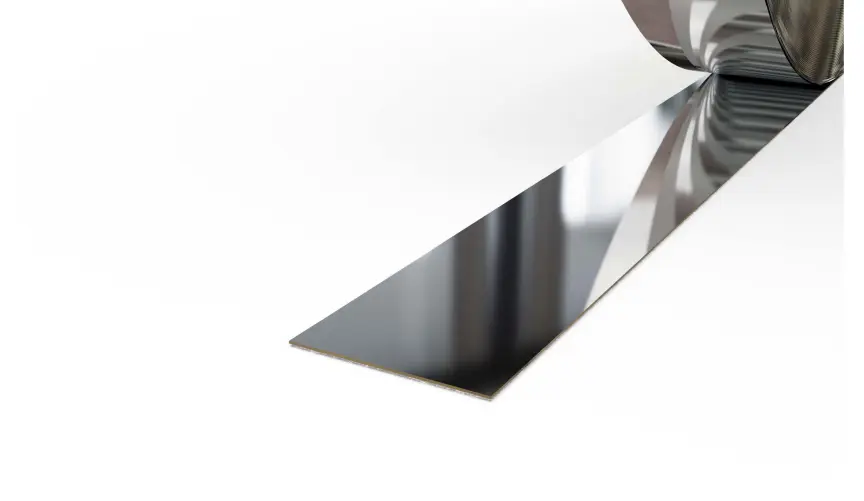
What hot-dip tinning achieves
In hot-dip tinning, strip with a cleaned and activated surface passes through a molten tin bath. After leaving the bath, a contactless air stream levels the liquid tin to the target thickness. Inline X-ray fluorescence measures coating thickness on both sides continuously throughout the process.
The result is a two-layer coating structure: an intermetallic phase (IMP) of Cu₃Sn and Cu₆Sn₅ bonds the tin metallurgically to the base material; a free tin layer above the IMP provides the contact surface.
This structure delivers four performance characteristics that conventional electroplated tin cannot replicate:
- Low contact resistance – the free tin embeds the mating partner over a large surface area, reducing resistance at the contact point
- High whisker resistance – IMP formation at elevated temperature relieves internal stresses that drive whisker growth
- Good corrosion resistance – a passivating, stable tin oxide forms without pores
- Good solderability – the free tin layer remains wettable across standard soldering processes
Coating Variants
What it is: SnPUR® is a pure hot-dip tin coating. The structure consists of a Cu₆Sn₅ intermetallic phase bonded to the base material, with a free pure tin layer on top.
When to use it: Applications requiring low contact resistance and good solderability at standard operating temperatures.
Key characteristics:
- Very ductile – accommodates stamping and bending without coating separation
- Low contact resistance through large, compliant contact surface
- Good solderability (improves with increasing coating thickness)
- Layer thickness range: 0.7 µm to 10 µm depending on application target
What it is: SnTEM® starts as a standard hot-dip tin coating and is then transformed by a subsequent heat treatment into a fully intermetallic CuSn compound. No free tin remains.
When to use it: Multipole connectors with high mating cycle requirements where insertion and withdrawal forces must be minimized and wear resistance maximized.
Key characteristics:
- Significantly lower friction coefficient than pure tin – reduces insertion/withdrawal forces
- High surface hardness (approx. 4 GPa nanohardness vs. <1 GPa for SnPUR®) – excellent wear resistance in repeated mating
- Layer thickness: 0.7 µm to 2 µm
- Not suitable for soldering applications
- Note: high hardness limits formability – confirm compatibility with bending radii before ordering
What it is: SnTOP® is a tin-silver hot-dip coating containing approximately 4% silver. The silver content causes precipitation hardening of the coating layer.
When to use it: Applications at elevated temperatures (up to 160 °C) where a combination of reduced insertion forces, fretting corrosion resistance, and solderability is required – as a cost-effective alternative to silver-plated surfaces.
Key characteristics:
- Operating temperature range: –40 °C to +160 °C
- Improved coefficient of friction vs. SnPUR® – lower insertion/withdrawal forces
- Good fretting corrosion resistance and abrasion resistance
- Good solderability maintained
- Good bending properties retained
The Advantage: The Intermetallic Phase (IMP)
The core characteristic of our hot-dip tinned coatings is the formation of a specialized intermetallic phase (IMP) between the base material and the tin layer.
Technical Specifications
We provide a wide range of dimensions to suit your specific manufacturing needs:
- Strip Thickness: Available from 0.1 mm to 2.0 mm.
- Strip Width: Available up to 400 mm.
- Edge Designs: Standard uncoated edges or specialized tinned edges upon request.
- Delivery Forms: Strips can be delivered in standard coils or as MULTICOIL® traverse wound coils for extended production runs.
Typical Applications