Cold Plates – for High-performance Liquid Cooling
Wieland designs and manufactures cold plates for demanding liquid cooling applications. The portfolio includes two lines of standard cold plates as well as semi-custom and custom cold plate options, allowing adaptation to different power electronics footprints and application-specific requirements.
The cold plates use patented Micro Deformation Technology inside and typically feature friction stir welded construction. Other joining methods such as vacuum brazing are also available. This combination supports high thermal performance, low pressure drop and competitive pricing.
- High thermal performance
- Low pressure drop
- Standard, semi-custom and custom options
- Scalable cold plate designs
- Friction stir welded construction
- Micro Deformation Technology inside
Product Variants
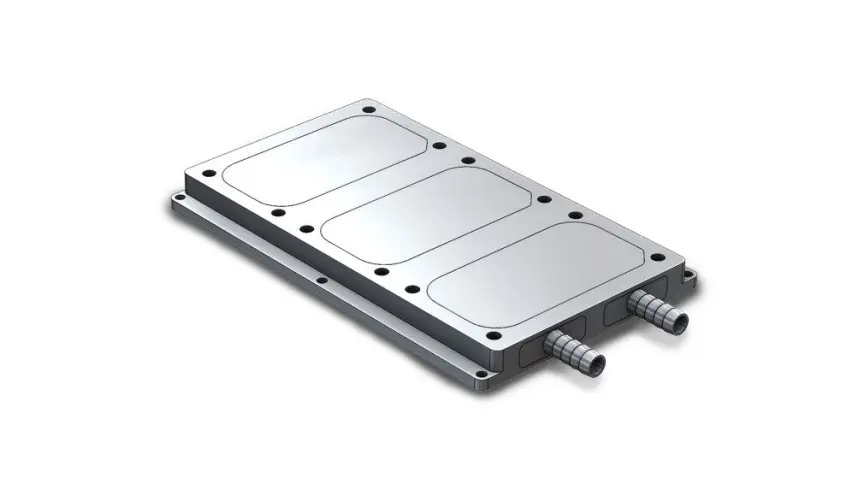
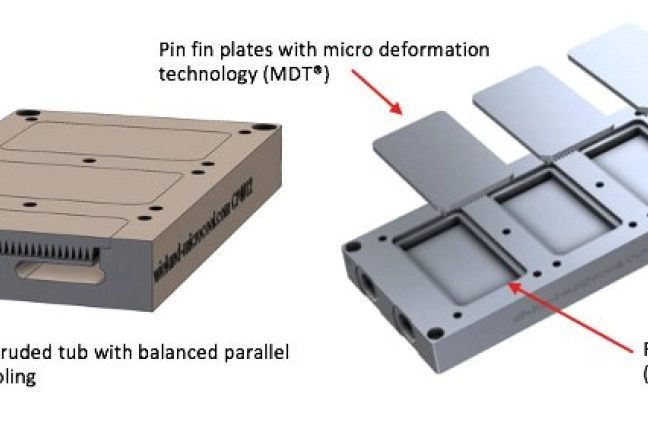
The 4000 Series cold plates are designed to fit the most common power electronics footprints and can be customized for other requirements. They use MDT™ pin fin technology, extruded and friction stir welded construction, and balanced parallel cooling.
At a glance
- Standard cold plate line
- Designed for common power electronics footprints
- MDT™ pin fin inside
- Extruded and friction stir welded construction
- Balanced parallel cooling
- Lower thermal resistance
- Lower pressure drop
- Competitive pricing
| Part number | Modules | Surface enhancement | Port fitting | Module bolt pattern | Dimensions |
|---|---|---|---|---|---|
| CP-E-4009-S3XJ | 3 | 20 FPI MDT | J1926 | 48 x 93 mm | 225 x 130 x 20 mm |
| CP-E-4012-S3XJ | 3 | 20 FPI MDT | J1926 | 44.75 x 71.75 mm | 190 x 90 x 20 mm |
| CP-E-4013-S3XJ | 3 | 20 FPI MDT | J1926 | 86 x 127 mm | 321 x 150 x 20 mm |
Custom cold plates are developed for applications where standard designs do not meet the required performance, geometry or integration needs. Wieland engineers develop custom micro-channel cold plate solutions using patented Micro Deformation Technology.
MDT is highly flexible and can create a wide variety of fin, pin and micro-channel geometries, allowing the cold plate to be adapted to specific cooling requirements.
At a glance
- Custom micro-channel cold plate design
- Developed for specific application requirements
- Designed to achieve defined performance requirements
- Based on patented Micro Deformation Technology
- Wide variety of fin, pin and micro-channel geometries
- Single-side and double-side plate options possible
Advantages
Wieland friction stir welded cold plates with Micro Deformation Technolgoy pin fin inside offer improved performance with less pressure drop compared to many cold plate designs on the market.
- 30% less thermal resistance
- 5x less pressure drop
- Balanced parallel cooling
Technologies
Micro Deformation Technology – for fin, pin and micro-channel geometries
Micro Deformation Technology is a non-subtractive manufacturing method for creating fin and pin surfaces for heat transfer applications. The process mechanically and plastically deforms the work piece to form finite and repeatable micro-channels.
MDT can generate straight fins and pins and can create a wide variety of fin, pin and micro-channel geometries without the need for a time-consuming tool change.
In addition to the MDT process, we also offer skiving and other specialized manufacturing technologies for customized applications, ensuring reliable cooling of high-performance computing chips.
Micro Deformation Technology
Micro Deformation Technology is a low-cost, non-subtractive manufacturing method for creating fin and pin surfaces for heat transfer applications. The patented process mechanically and plastically deforms the work piece to form finite and repeatable micro-channels.
MDT can generate both straight fins and pins and can be performed on virtually any ductile material, including titanium, stainless steel, silver, aluminum and copper. It can also be applied to non-metallic materials such as Teflon, polyethylene, rubber and PVC.
| MDT option | Specification |
|---|---|
| Fins per inch | 650 – 5 FPI |
| Fin thickness to fin gap ratio | 1:0.2 – 1:3 |
| Fin height to fin thickness ratio | Up to 30:1 |
| Max fin gap | 2.5 mm for straight fins, 1.2 mm+ for pins |
| Pin pattern | In-line or staggered |
| Pin diameter and gap | 1 mm to 0.5 mm |
| Pin height to diameter ratio | Up to 8:1 |
| Surface area | Up to 1 x 1 meter |
| Placement | Specific island locations or across the entire surface |
| Plate design | Fins or pins can be added as single-side or double-side plate |

Friction Stir Welding – for reliable cold plate joining
Friction Stir Welding is a solid-state joining process. Frictional heat is generated between the welding tool and the material of the work pieces, joining the work pieces while staying below the melting point. This creates a leak-proof seal for cold plate joining. We use friction stir welding for high-conductivity 1100 series aluminum Micro Deformation Technology pin plates into machined, extruded and cast aluminum alloys.
Manufacturing technologies
From extrusion and casting to CNC machining, plating, stamping and brazing, Wieland supports the development and production of standard and custom cold plates. Finished cold plates can be tested for leak and pressure.
| Manufacturing capability | Description |
| Extrusion | Library of extrusions to fit 90% of today’s power electronics requiring liquid cooling. Custom extrusions can also be designed and manufactured quickly and cost-effectively. |
| Casting | Casting design for liquid cooling and friction stir welding, including the integration of MDT pin plates into cast inverter enclosures. |
| CNC machining | CNC machining centers and CAM programming are used to produce liquid cold plate components, maintain close tolerances on complex parts and build tools and fixtures. |
| Plating | Electroless nickel plating ensures uniform plating thickness across intricate fin patterns, such as twisted MicroCool pins. Electrolytic nickel plating and other plating or surface treatments are also available. |
| Stamping | Soft tool prototypes, short-run production for blanking and deep drawing, and high-volume stamping are available. Specified bow can be added to IGBT base plates to counter thermal distortion from semiconductor die soldering. |
| Brazing and soldering | If FSW cannot be used, aluminum cold plates can typically be joined by vacuum brazing or torch brazing. Copper cold plates can be joined by batch furnace brazing or continuous furnace brazing. |
| Heat treating | Heat treating is available for parts that need to be stress relieved, annealed or aged. |
| Quality assurance and testing | Quality assurance testing includes video comparator, coordinate measuring machine, digital microscope and metallography capabilities. Finished cold plates can be leak and pressure tested. Mass production facilities are ISO 9001 registered. |