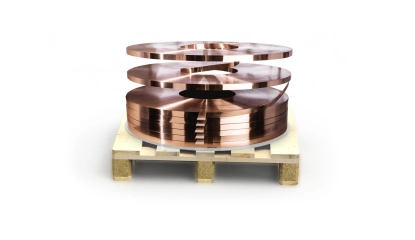
Brass Strips and Foils

Wieland Brass Strips and Foils combines workable strength with the lowest metal cost in the copper-alloy family, since zinc is significantly cheaper than copper. Standard brasses like M30 and M36 are the economical choice for connectors and components without extreme thermal or corrosion demands, while special brasses add strength and thermal stability through additional alloying elements.
Additional information


Material overview

ASTM-UNS No.
Wieland Designation ⁠EN Designation EN No. JIS No. Data Sheet
C21000
M05 CuZn5 CW500L C2100 download
C22000
M10 CuZn10 CW501L C2200 download
C23000
M15 CuZn15 CW502L C2300 download
C24000
M20 CuZn20 CW503L C2400 download
C26000
M30 CuZn30 CW505L C2600 download
C26800
M33 CuZn33 CW506L C2680 download
C26800 / C27000
M36 CuZn36 CW507L C2700 download
C27200
M37 CuZn37 CW508L C2720 download
C27200
M38 CuZn37 CW508L C2720 download
C42500
S12 CuSn3Zn9 CW454K C4250 download
C68800
S23 CuZn23Al3Co CW703R - download
-
M42 CuZn42 CW510L - download
C25600
M28 CuZn28 CW504L - -

Choosing the Right Brass Grade


Brass is a copper-zinc alloy with zinc content up to 38%. Its main advantage is cost: zinc is significantly cheaper than copper, making brass strip the economical base material where extreme conductivity or strength is not required. Special brasses (S12, S23) add alloying elements to increase strength and thermal properties. Trade-offs include lower temperature resistance, susceptibility to stress-corrosion cracking, and a risk of zinc evaporation during arc welding. Brass and special brass are therefore applied in less critical connector applications.


Not sure which grade or plating fits your process? Our Alloy Wizard helps you identify the right brass grade based on your application requirements, while the Plating Wizard makes it easy to compare different plating options and find the optimal surface solution.

Available Dimensions


Strip thickness0.10–1.50 mm (thicker gauges on request)
Strip widthstandard up to 200 mm per EN 1652 (wider on request)


Delivery Formats


Typical Applications


Uncritical connectors and contacts where cost matters more than maximum conductivity or thermal-relaxation resistance.

Downloads