

Immersion Cooling for High-Performance Systems
Wieland provides liquid cooling technologies for systems with highest power densities. Immersion Cooling is one of the key technologies within the electronics cooling portfolio. With integrated supply-chain and in-house manufacturing capabilities, Wieland supports both standard solutions for fast delivery and customized designs at any scale. Our engineers can co-develop cooling systems together with customers to meet individual efficiency and performance requirements.
- Efficient cooling for highest power densities
- Standard portfolio for fast delivery
- Customized designs at any scale
- Integrated supply-chain and manufacturing capabilities
- Engineering and co-development support
- Scalable solutions for increasing demand
Product Variants
There are basically two different methods of applying Immersion Cooling: single-phase Immersion Cooling and the two-phase Immersion Cooling method. They form the basis of most Immersion Cooling technologies.
One-phase Immersion Cooling
The liquid absorbs heat and remains in a liquid state. Our approach on one-phase Immersion Cooling is focused on design-for-manufacturing. Due to the integrated supply-chain and manufacturing capabilities in house, we are a reliable partner that enables you to scale the demand.
Two-phase Immersion Cooling
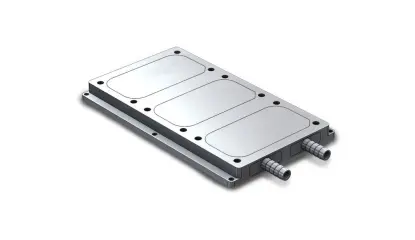
Our two-phase Immersion Cooling components allow highest possible density for cooling. The liquid changes to gas when it absorbs heat and then condenses back to liquid. This not only saves you up to 97% energy in your data centers – our components also lead to massive space savings in your data center.
Our integrated design can save up to 30% space. Moreover the Two-phase Immersion Cooling can reduce energy costs by up to 97% compared with conventional cooling methods in data center applications.
| Parameter | Performance |
| Capacity range | 40–800+ kW |
| Space savings | Up to 30% |
| Energy savings with two-phase cooling | Up to 97% |
| Power Usage Effectiveness | 1.01 |
| Cooling power compared with air | Up to 20× higher |
Typical Applications
- Data Centers & AI Computing
- Power Electronics
- Automotive & E-Mobility
- Telecommunications
- Industrial Electronics
- Aerospace & Defense